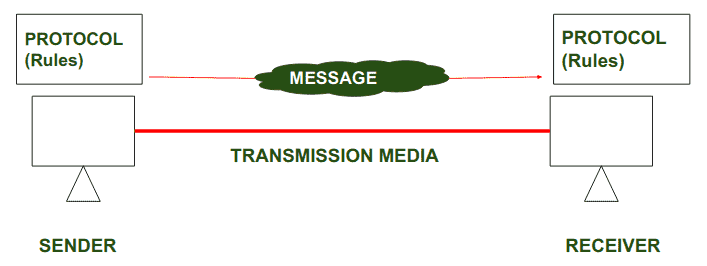
Standardized rules that enable reliable, secure, and efficient communication between devices on a network are termed as network protocols.
- Defines how data is transmitted, received, and interpreted across networks.
- Ensure interoperability between devices from different manufacturers.
- Maintain data integrity and prevent transmission errors.
- Optimize network efficiency and resource usage.
- Provide security through encryption, authentication, and secure communication.
Important Network Protocols
Below are some of the important network protocols:
1. Network Time Protocol (NTP)
Used to synchronize the clocks of computer systems over data networks, Network Time Protocol (NTP) was designed by David L. Mills.
- NTP allows devices on a network to synchronize their time settings with an NTP server.
- It is one of the oldest and most widely used Internet protocols today.
- Accurate time synchronization is crucial for logging events, secure communications, and scheduling tasks in distributed systems.
2. Domain Name System (DNS)
Resolves a website address (Uniform Resource Locator) into its corresponding IP address, a process handled by the DNS.
- When users type a web address in their browser, they rely on DNS servers to resolve the actual IP address of the destination.
- DNS acts as the Internet’s phonebook, translating domain names like
www.example.cominto IP addresses like192.168.1.1.
3. Routing Information Protocol (RIP)
Helps data packets determine the best path across a network, a function performed by the RIP.
- It limits the number of hops from the source to the destination to 15, preventing infinite routing loops.
- RIP determines the best route based on hop count.
- Mechanisms like split horizon, route poisoning, and holddown timers are used to improve routing efficiency and stability.
4. Dynamic Host Configuration Protocol (DHCP)
Automatically assigns IP addresses and other configuration details to devices on a network using the Dynamic Host Configuration Protocol (DHCP) .
- When a device connects to a network, it requests an IP address from the DHCP server.
- The server responds by allocating an IP address, effectively giving the device permission to use the network.
- DHCP is standardized under RFC 2131 and simplifies network management by eliminating the need for manual IP address assignment.
Organizations that Define Network Protocols
Several organizations establish and maintain networking standards and protocols:
- IEEE (Institute of Electrical and Electronics Engineers): Creates standards for local area networks and hardware.
- IETF (Internet Engineering Task Force): Develops Internet protocols and standards.
- ISO (International Organization for Standardization): Defines global networking standards.
- ITU (International Telecommunication Union): Establishes communication protocols for telecommunication networks.
- W3C (World Wide Web Consortium): Develops standards for the World Wide Web.
While protocol models generally function in similar ways, each protocol is unique and works according to detailed specifications defined by its standardizing organization.